
Paid advertising for lead generation is the process of using paid placements on platforms like Google Ads or Meta to attract prospects who are actively searching for your service. For small businesses, it is the fastest way to get measurable enquiries without waiting months for organic search to deliver results. Unlike content marketing or SEO, paid ads put your offer in front of high-intent buyers the moment they search.
The industry term for this practice is paid search lead generation, and understanding how it works is the first step to building a system that consistently fills your pipeline with quality leads.
How to generate leads with paid ads as a small business
Paid ads generate leads because they intercept demand at the exact moment it exists. Someone searching for “emergency pipe repair in Cape Town” is not browsing. That person needs help now, and a well-placed search ad captures that intent before any organic result does. Search ads excel at capturing high-intent demand, while social and display ads serve creative testing and demand creation. That distinction matters when you are deciding where to spend a limited budget.

The core principle for paid ads is simple. You pay for clicks from people who match your targeting criteria, send them to a landing page, and capture their contact details through a form or phone call. A great ad with a weak landing page wastes your spend. A strong landing page with vague targeting attracts the wrong people. At SCOPE, we work with service businesses daily and the pattern is consistent: the businesses that win with paid ads treat the whole funnel as one connected system, not a collection of separate tasks.
What do you need before launching a paid ad campaign?
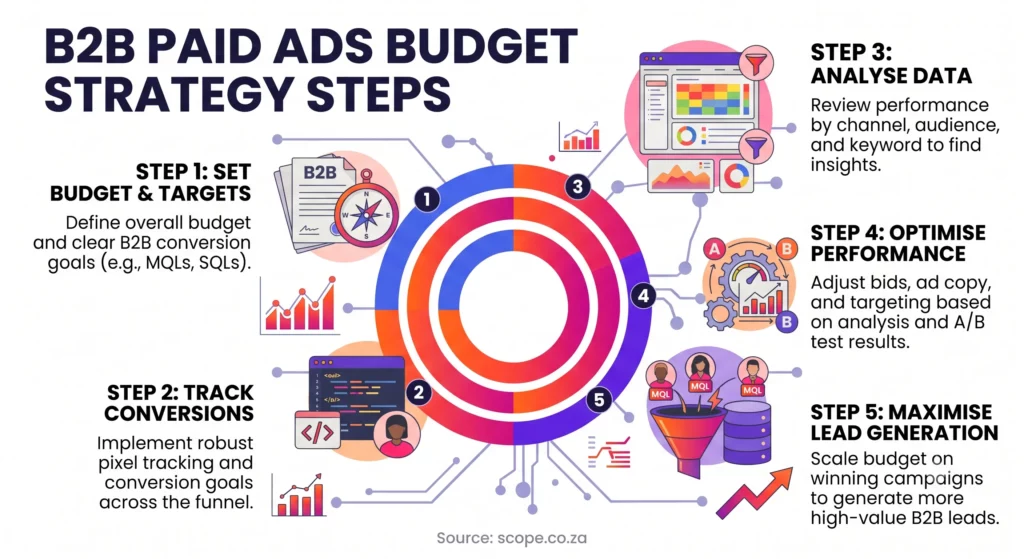
Setting everything up correctly before spending a single cent is the most important decision you will make. Campaigns without conversion tracking run blind, unable to optimise for true ROI or identify which ads are producing real leads. Set up Google Ads conversion tracking correctly before your campaign goes live, not after Install Google Tag Manager, set up a thank-you page trigger or a call tracking number, and confirm that every conversion fires correctly before your campaign goes live.
Beyond tracking, you need three core assets:
- A dedicated landing page that matches the ad’s message, loads in under three seconds, and has one clear call to action.
- A contact capture form that asks only for the information you genuinely need. Name, phone number, and a brief description of the enquiry is usually enough.
- Ad creatives that speak directly to the problem your prospect is trying to solve.
Budget ranges for small businesses
Small business budgets from R5,000 to R10,000 per month allow gathering sufficient data (100–300 clicks) to generate leads with moderate competition on Google Ads. At a 5% conversion rate, that spend could generate 5–15 leads per month (CPC dependent).
| Asset | Purpose | Minimum requirement |
|---|---|---|
| Conversion tracking | Measures real leads, not just clicks | Google Tag Manager + goal setup |
| Landing page | Converts clicks into enquiries | One page, one offer, one form |
| Ad creatives | Attracts the right clicks | Two to three ad variations per ad group |
| Monthly budget | The ability to run ads | R5,000 – R10,000 |
| Contact capture form | Collects lead details | Name, phone, brief enquiry field |
Pro Tip: Before you go live with your campaign, test your form submission manually and confirm the conversion fires in Google Ads. If tracking is broken from day one, you will have no data to work with when you need it the most.
How do you structure a paid ad campaign to attract quality leads?
Campaign structure determines whether your budget reaches the right people or gets diluted across irrelevant searches. The most effective approach for small businesses is to start with a tightly themed search campaign built around your high-intent keywords. These are phrases that signal buying intent, such as “hire a bookkeeper in Cape Town” or “emergency electrician near me,” rather than broad informational queries like “how does accounting work.”
Follow these steps when building your first campaign:
- Conduct keyword research using Google Keyword Planner. Focus on phrases with clear commercial intent and manageable search volume. Avoid broad match keywords in the early stages; they spend budget on irrelevant queries.
- Build a negative keyword list from day one. Add terms like “free,” “DIY,” “course,” and “jobs” to prevent your ads from showing to people who will never buy. If unqualified submissions persist beyond a negative keyword list, see our guide to fixing Google Ads spam leads.
- Write ad copy that mirrors the search query. If someone searches “accountant for small business,” your headline should include that phrase. Relevance improves your Quality Score and lowers your cost per click.
- Add lead form assets directly to your Google Ads. These allow prospects to submit their details without leaving the search results page, which reduces friction and increases conversion rates.
Comparing campaign types for small business lead generation
| Campaign type | Best for | Lead intent level |
|---|---|---|
| Google Search | Capturing active demand | High |
| Meta (Facebook/Instagram) | Demand creation and retargeting | Medium |
| Google Display | Brand awareness and remarketing | Low to medium |
| YouTube pre-roll | Visual service demonstration | Low to medium |
How do you optimise paid ad campaigns to improve lead quality over time?
The first two weeks of a Google Ads campaign constitute a learning phase where results often appear poor but the algorithm collects data to optimise efficiently later. Frequent tweaks during this period reset algorithm progress and waste budget. The correct approach is to set up correctly, let the campaign run, and review performance after the learning phase ends.
Once the learning phase is complete, focus on these areas:
- Search term reports: Review which actual search queries triggered your ads. Add irrelevant terms to your negative keyword list weekly.
- Ad performance: Pause ads with a low click-through rate and test new headlines against your top performer.
- Landing page conversion rate: If your page converts below 3%, test a shorter form, a stronger headline, or a more specific offer.
- Budget reallocation: Move budget from underperforming ad groups to those producing the lowest cost per lead.
- Audience signals: On Meta, review which age groups, locations, and interest segments produce the most form submissions.
Smart bidding algorithms depend heavily on consistent, clean conversion tracking data to learn and improve targeting and spend efficiency. If your tracking fires incorrectly or inconsistently, the algorithm optimises for the wrong signals and your lead quality drops.
What should you do when paid ads are not generating enough leads?
Low lead volume is the most common complaint from small business owners running paid ads for the first time. The cause is almost always one of three things: the budget is too low to generate sufficient data, the campaign was changed too early during the learning phase, or the landing page is not converting clicks into enquiries.
Poor campaign results often stem from budgets that are too low, leading to insufficient data for algorithms, or from impatience causing premature campaign changes. Leaving campaigns untouched during the learning phase yields better optimisation later.
Work through this checklist when lead volume drops:
- Confirm your conversion tracking is firing correctly. Check Google Tag Manager’s preview mode.
- Review your daily budget. If your ads are not showing for the full day, your budget is too low for your target keywords.
- Check your search impression share. If it is below 50%, you are losing visibility to competitors with higher bids or better Quality Scores.
- Audit your landing page on mobile. Most paid traffic arrives on mobile devices, and a slow or cluttered mobile page kills conversions.
- Review your lead follow-up speed. Leads contacted within five minutes are 100 times more likely to convert than those followed up after 2 hours. If your team takes hours to respond, you are losing leads that your ads already paid for.
Key takeaways
Paid advertising in lead generation works when you combine clean tracking, a realistic budget, disciplined campaign structure, and fast lead follow-up into one connected system.
| Point | Details |
|---|---|
| Set up tracking first | Campaigns without conversion tracking cannot optimise for real leads or ROI. |
| Budget for data, not profit | Treat your first R5,000 – R10,000 as a testing investment to identify what works. |
| Respect the learning phase | Leave campaigns untouched for at least two weeks so the algorithm can gather data. |
| Follow up leads within five minutes | Speed of response is the single biggest factor in converting paid leads into clients. |
What I have learned running paid ads for service businesses
The most common mistake I see small business owners make is treating paid ads like a light switch. They expect to turn the campaign on and receive leads within 48 hours. When that does not happen, they start changing headlines, adjusting bids, and switching keywords. Every change resets the learning phase and the cycle repeats.
The businesses that get consistent results do the opposite. They set up their tracking carefully, build a focused campaign structure, and then leave it alone for two weeks. They use that time to prepare their lead follow-up process, whether that is a CRM, an automated email sequence, or a dedicated phone line. Marketing experts emphasise using the initial budget as a data gathering and audience testing phase rather than expecting immediate profitability. That mindset shift changes everything.
The second lesson is that the ad is only half the job. I have seen campaigns with excellent click-through rates produce almost no leads because the landing page was generic or the form asked for too much information. The ad gets the click. The landing page earns the enquiry. Both need the same level of attention.
Finally, speed of response matters more than most business owners realise. Paying for a lead and then calling back two days later is the equivalent of leaving money on the table. Build your follow-up process before you launch, not after.
Warren Bright, Founder of SCOPE Digital Agency
How SCOPE helps small businesses generate leads through paid ads
Running paid ads without a clear system produces inconsistent results and wasted spend. SCOPE is a Cape Town-based digital agency that builds and manages paid media campaigns specifically for service businesses that need measurable lead generation, not just impressions and clicks.
We handle campaign setup, conversion tracking, ad creation, and ongoing optimisation so you can focus on selling to the leads that come in. We advise you on lead follow-up workflows to make sure every enquiry your ads generate gets a fast, professional response. We handle this through a purpose-built CRM that connects your sales pipeline to Google Ads, so every lead is tracked back to real revenue, not just a form fill If you want a paid advertising system built around your business goals and budget, get in touch with us to discuss what that looks like for your specific market.
If you want to compare providers before committing, our roundup of the best lead generation companies in South Africa is a good place to start.
Frequently Asked Questions
What is the minimum budget for paid ads lead generation?
A monthly budget of R5,000 – R10,000 is the practical minimum for generating meaningful data on Google Ads with moderate competition. Below that threshold, campaigns rarely accumulate enough clicks to produce reliable lead volume or feed the algorithm sufficient data.
Why are my paid ads getting clicks but no leads?
Clicks without leads almost always point to a landing page problem. Check that your page loads quickly on mobile, that your form is short and clear, and that your offer matches exactly what the ad promised.
How long does it take for paid ads to generate leads?
Most campaigns begin producing leads within the first two to four weeks, though the first two weeks are a learning phase where results are often inconsistent. Consistent lead flow typically stabilises after four to six weeks of uninterrupted running.
How quickly should I follow up with a paid ad lead?
Leads contacted within five minutes are 100 times more likely to convert than those followed up after 2 hours. Use an automated notification or CRM alert to contact every new lead immediately.
When should I switch to automated bidding on Google Ads?
Switch to automated bidding strategies like Maximise Conversions or Target CPA only after accumulating 50 – 100 conversions. Switching earlier gives the algorithm too little data to make reliable decisions, which increases your cost per lead.