Search engine marketing (SEM) is defined as the orchestration of three distinct channels: paid search advertising (PPC), organic search optimisation (SEO), and AI-driven search visibility. Each channel targets buyers at different stages of their decision process. Together, they form a single, coordinated system for capturing demand across every major search surface, from Google and Bing to ChatGPT and Perplexity.
The definition of search engine marketing has expanded significantly. AI Overviews now appear on roughly 20.5% of all SERPs and that figure is growing. Ignoring any one of the three channels means leaving qualified traffic on the table.
What is search engine marketing made of?
SEM is an orchestration of paid search, SEO, and AI visibility, not a single tactic. Each component serves a distinct purpose, and the three work best when they share data and reinforce each other.

Paid search (PPC) delivers results fast. You bid on keywords, your ad appears at the top of the results page, and you pay only when someone clicks. This makes PPC the right tool when you need leads now or when you are entering a new market and have no organic footprint yet.
Organic search (SEO) builds a long-term asset. It typically takes 6–12 months to rank competitively for high-value terms, but once you do, that traffic costs nothing per click. SEO rewards consistency: well-structured content, authoritative backlinks, and technical site health compound over time.
AI-driven search visibility is the newest component. Platforms like Google AI Mode, ChatGPT, and Perplexity generate direct answers from indexed content. If your content is not structured to be cited by these systems, you are invisible to a growing share of buyers who never scroll past the AI answer box.
The table below compares the three channels across the dimensions that matter most for budget and planning decisions.
| Channel | Speed to results | Cost model | Longevity | Primary goal |
|---|---|---|---|---|
| Paid search (PPC) | Immediate | Cost per click | Stops when budget stops | Short-term lead generation |
| Organic search (SEO) | 6–12 months | Time and content investment | Compounds over time | Long-term traffic asset |
| AI search visibility | Medium-term | Content and structure investment | Grows with AI adoption | Brand citation and reach |
How do you prioritise keywords for SEM?
Keyword selection is where most SEM strategies either win or waste money. Bottom-of-funnel queries, such as pricing, alternatives, and buy-online searches, generate the highest ROI in SEM campaigns. That is because the person typing “accounting software pricing” is far closer to a purchase decision than someone searching “what is accounting software.”
The shift in modern SEM is away from raw search volume and towards intent and conversion potential. A keyword with 200 monthly searches and a clear purchase intent outperforms a keyword with 20,000 searches and vague informational intent. Your keyword research should answer one question: does this query come from someone who is ready to act?
Integrating your organic and paid keyword strategies multiplies the value of both. When you identify a keyword that converts well in your paid campaigns, that is a signal to build organic content around it. When a page ranks in the top three organically, that is a signal to test whether paid spend on that term is redundant.
- Prioritise by intent first. Group keywords into informational, commercial, and transactional categories before assigning budget.
- Use paid data to validate organic targets. A keyword that converts in PPC is worth the investment in organic content.
- Build a negative keyword list. Exclude irrelevant queries to cut wasteful clicks and improve your cost per conversion.
- Review search term reports weekly. Actual search queries often differ from the keywords you bid on, and the gaps reveal new opportunities.
Pro Tip: When a keyword performs well in both paid and organic, run a split period test. Pause paid spend for two to four weeks and measure whether organic traffic fills the gap. This tells you exactly how much of your paid spend is cannibalising traffic you would have captured for free.
Why does unifying organic and paid data matter?
Effective SEM requires merging organic and paid data into a single decision loop, covering impressions, click-through rate (CTR), cost per click (CPC), and conversion rate. Without this, your SEO team and your paid media team optimise in isolation, and you end up paying for traffic your organic rankings already deliver.
The consequences of siloed campaigns are concrete. You bid on a keyword your site already ranks first for organically. You pay a CPC of £4.50 for clicks you could have received at no cost. Multiply that across dozens of keywords and the budget waste becomes significant over a quarter.
A unified data approach creates a clear decision framework:
- Map organic rankings against paid keywords. Any keyword where you rank in positions 1–3 organically is a candidate for reduced or paused paid spend.
- Monitor cannibalisation. Reducing paid spend on high-ranking organic keywords tests whether organic performance holds without ad support.
- Reallocate freed budget. Move spend to keywords where you have no organic presence and where paid is the only way to compete.
- Set a review cadence. Revisit the organic versus paid overlap monthly, not quarterly. Rankings shift and so should your budget.
Pro Tip: Track incrementality, not just total conversions. The question is not “did this keyword generate a conversion?” but “would this conversion have happened without the paid ad?” Incrementality measurement prevents you from crediting paid campaigns for sales that organic would have closed anyway.
How does AI-driven search visibility shape SEM?
Zero-click behaviour and generative AI answers have fundamentally changed search. A growing share of users receive a complete answer from an AI overview and never click through to any website. For SEM practitioners, this creates a new visibility problem that neither PPC nor traditional SEO fully solves.
AI search visibility means optimising for citations in AI-generated answers on platforms like ChatGPT, Perplexity, and Google AI Mode. When these systems generate a response, they pull from content that is clearly structured, factually specific, and authoritative. Vague, generic content does not get cited.
The practical implications for your SEM strategy are direct:
- Structure content for direct answers. Use clear headings, concise definitions, and specific data points. AI systems favour content that answers a question in the first two sentences of a section.
- Build topical authority. A site that covers a subject comprehensively is more likely to be cited than one with a single page on the topic.
- Monitor your AI citations. Tools that track brand mentions in AI-generated answers are emerging. Use them to measure your AI visibility the same way you track organic rankings.
- Do not abandon PPC. AI overviews appear on 20.5% of SERPs, which means paid ads still dominate the remaining majority. PPC and AI visibility are complementary, not competing.
The relationship between AI visibility and traditional SEM is additive. Brands that appear in AI answers, rank organically, and run paid ads occupy three distinct positions on the same results page. That level of presence is difficult for any competitor to displace.
What steps build an effective SEM strategy in 2026?
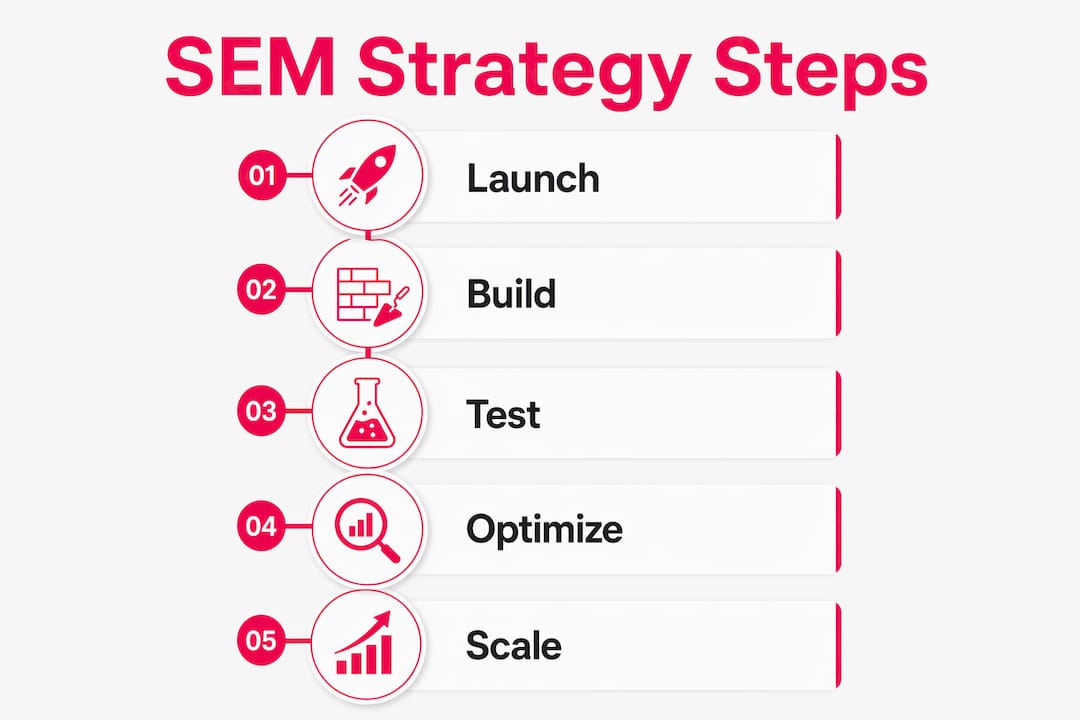
Coordinating SEO and paid campaigns prevents overlap and reduces unnecessary ad spend. The practical framework below gives you a structured way to allocate effort and budget across all three SEM channels.
| Phase | Focus | Channel | Timeline |
|---|---|---|---|
| Launch | Immediate lead generation | PPC | Months 1–3 |
| Build | Content and authority development | SEO | Months 3–12 |
| Integrate | Unified data review and budget reallocation | PPC + SEO | Ongoing |
| Expand | AI citation and visibility optimisation | AI search | Months 6+ |
Paid search acts as a short-term ramp while SEO builds a long-term asset across the same keyword intent. This dual approach reduces budget dependency over time. As your organic rankings improve, you can shift paid spend towards new markets or higher-competition terms where organic traction takes longer.
Testing is non-negotiable. Allocate a portion of your monthly budget specifically for keyword experiments. Run new ad copy, test landing page variants, and measure which combinations produce the lowest cost per lead. Feed those findings back into your organic content strategy.
Building an evidence-driven SEM operating framework means every budget decision traces back to data. You do not increase PPC spend because a campaign “feels” like it is working. You increase it because your cost per acquisition is below target and your conversion rate justifies scaling.
Key takeaways
SEM is the coordinated management of paid search, organic SEO, and AI-driven visibility to capture demand across every major search surface.
| Point | Details |
|---|---|
| SEM has three channels | Paid search, organic SEO, and AI visibility each serve a distinct role and work best together. |
| Intent beats volume | Bottom-of-funnel keywords with purchase intent deliver higher ROI than high-volume informational queries. |
| Unified data prevents waste | Merging organic and paid metrics into one decision loop stops you paying for traffic organic rankings already capture. |
| AI visibility is now essential | AI Overviews appear on 20.5% of SERPs; content must be structured to earn citations in AI-generated answers. |
| Test cannibalisation actively | Pausing paid spend on top-ranking organic keywords reveals how much budget you can reallocate without losing leads. |
SEM in practice: what I have learned running paid and organic together
The biggest mistake I see businesses make is treating SEM as a synonym for Google Ads. They run paid campaigns, call it “search marketing,” and wonder why results plateau after three months. The plateau is almost always caused by the same problem: no organic foundation and no AI presence to sustain visibility when ad budgets tighten.
What actually works is treating the three channels as a single system with shared data. When I review a client’s SEM performance, the first thing I look at is the overlap between their top organic keywords and their paid keyword list. The waste I find there is usually the fastest source of budget savings, and those savings fund the content investment that builds long-term rankings.
The AI visibility piece is where I see the most scepticism from experienced marketers. They have spent years mastering PPC and SEO, and AI search feels like a moving target. My view is straightforward: if your content answers questions clearly and specifically, it will be cited. The same discipline that makes good SEO content makes AI-citable content. The skills transfer directly.
The hardest part of integrated SEM is organisational, not technical. When your paid media team and your SEO team sit in separate silos and report to different managers, data does not flow between them. Fixing that structure is more valuable than any individual tactic.
— Warren
How Scope approaches SEM for service businesses
Scope is a Cape Town-based digital agency specialising in paid media for service businesses. If you are running paid campaigns without a clear view of how they interact with your organic rankings and AI visibility, you are almost certainly overspending. Scope builds integrated SEM strategies that connect paid search, SEO, and AI search optimisation into a single, data-driven system. The goal is straightforward: more qualified leads at a lower cost per acquisition, with a clear plan for reducing paid dependency as organic performance grows. If you want a clear picture of where your current SEM strategy is losing budget, speak to the Scope team directly.
FAQ
What is the definition of search engine marketing?
Search engine marketing is the coordinated use of paid search advertising, organic SEO, and AI-driven search visibility to increase a website’s presence on search engine results pages and drive qualified traffic.
What is the difference between SEM and SEO?
SEO is one component of SEM, focused on earning organic rankings over time. SEM is the broader framework that includes paid search and AI visibility alongside organic optimisation.
How long does search engine marketing take to show results?
Paid search delivers results immediately. Organic SEO typically takes 6–12 months to build competitive rankings. AI visibility grows as your content earns citations in AI-generated answers over time.
What are the most effective search engine marketing techniques in 2026?
The most effective techniques combine bottom-of-funnel keyword targeting in paid campaigns, authoritative content for organic rankings, and clearly structured pages optimised for AI citation across platforms like Google AI Mode and Perplexity.
How do you avoid wasting budget in SEM?
Unify your organic and paid data into a single reporting view, identify keywords where organic rankings already capture traffic, and pause or reduce paid spend on those terms to reallocate budget where it generates incremental results.