Poor conversion tracking, misaligned landing pages, and weak keyword targeting are the primary reasons why your Google Ads aren’t working. A study of 15,666 accounts found the average account wastes over R18,000 monthly, with 29% recording zero conversions over 90 days due to tracking gaps. That figure is not a reflection of Google Ads as a channel. It is a reflection of how those campaigns were built and managed. The good news is that each of these failures has a clear cause and a clear fix. This guide walks you through the most common Google Ads performance issues, how to diagnose them, and what to do next.
Why your Google Ads aren’t working: start with conversion tracking
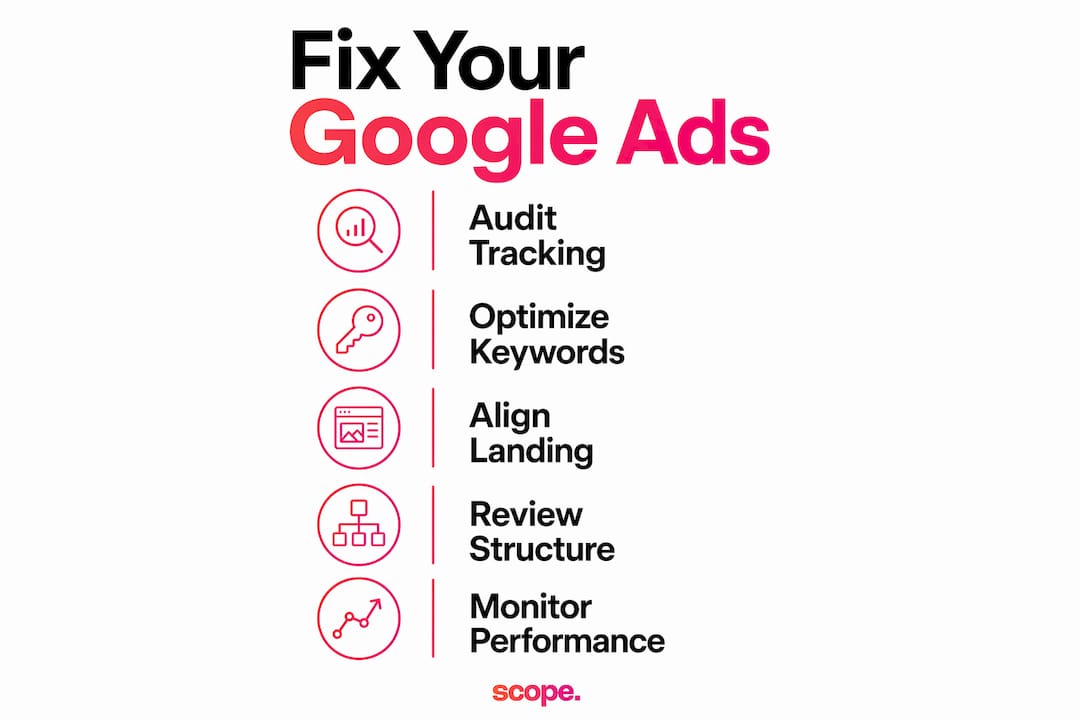
Conversion tracking is the foundation of every Google Ads campaign. Without it, you are flying blind. Google’s machine learning relies entirely on conversion data to decide which clicks to chase, which audiences to target, and how to adjust bids. Feed it bad data, and it will optimise for the wrong customers, spending your budget on people who will never buy.
The most common tracking errors include:
Duplicate conversions: The same action fires twice, inflating your numbers and misleading Smart Bidding.
Wrong trigger pages: The conversion tag fires on a page other than the actual thank-you or confirmation page.
GCLID parameter loss: Cross-domain redirects strip the Google Click ID from the URL, breaking attribution entirely.
Misaligned goals: Tracking soft actions like page views instead of actual leads or sales.
Discrepancies between Google Ads reported conversions and your CRM data are normal up to 10–15%. A gap above 40% signals a serious tracking problem that needs immediate attention. Before you change a single bid or pause a keyword, audit your tracking setup. Our conversion tracking setup guide walks you through exactly how to do this correctly.
Why do campaign structure and keyword strategy cause Google Ads to fail?
Most campaign failures stem from poor structural decisions. Campaigns built around internal service categories rather than how buyers actually search are set up to underperform from day one. A plumbing company that structures campaigns around “residential services” and “commercial services” is thinking about its own business, not about what a customer types into Google at 9pm with a burst pipe.
Effective campaign segmentation requires separating five distinct campaign types, each with its own budget and dedicated landing page:
Branded campaigns: Protect your brand name and capture high-intent searches from people already aware of you.
Core service campaigns: Target transactional keywords directly tied to what you sell, such as “emergency plumber Cape Town.”
Location-based campaigns: Separate campaigns per area if you serve multiple locations, so bids and budgets reflect local demand.
Competitor and comparative campaigns: Capture buyers who are actively comparing options and are close to a decision.
Retargeting campaigns: Re-engage visitors who showed intent but did not convert on their first visit.
Keyword match type discipline matters just as much as structure. Broad match keywords waste up to 40% of budget on informational queries with near-zero purchase intent. Someone searching “how does plumbing work” is not buying anything today. Mixing that traffic with your transactional campaigns dilutes your spend and confuses the algorithm. Build a negative keyword list from day one and review your search terms report weekly. Our keyword research guide covers intent mapping in detail.

How does landing page relevance affect Google Ads conversions?
Your ad earns the click. Your landing page earns the conversion. These two things must tell the same story. When a user clicks an ad for “emergency roof repairs in Johannesburg” and lands on a generic homepage about your construction company, the disconnect is immediate. They leave. That bounce raises your bounce rate above 70% and pushes your conversion rate below 1%, both of which damage your Quality Score and drive up your cost per click.
The average Quality Score across accounts sits at 5 – 6 out of 10. A score below 7 increases your cost per click and reduces your ad rank. Landing page relevance is one of the three components Google uses to calculate Quality Score, alongside expected click-through rate and ad relevance. Improving your landing pages is one of the fastest ways to reduce what you pay per click.
Strong landing pages share these characteristics:
Headline matches the ad: If your ad says “Same-day roof repairs,” your landing page headline must say the same or something very close.
Single, clear call to action: One goal per page. A phone number, a form, or a booking button. Not all three competing for attention.
Fast load speed: Pages that take longer than three seconds to load lose a significant portion of mobile visitors before they even see your offer.
Mobile-first design: The majority of Google searches happen on mobile. A page that works on desktop but breaks on a phone loses those visitors entirely.
What external factors affect Google Ads performance in 2026?
Not every performance drop is your fault. Google’s platform changes and broader privacy shifts have altered how campaigns report results, and many business owners misread these changes as campaign failure.
Google’s Consent Mode and evolving browser privacy restrictions collect less direct conversion data, forcing a recalibration of how you set performance benchmarks. Your lead volume may be steady while your reported conversions appear lower. This is the “new normal” in 2026, not a sign that your campaigns have stopped working.
| Factor | What it means | What to do |
|---|---|---|
| Consent Mode | Fewer consented users tracked directly | Use modelled conversions; compare CRM data |
| Browser restrictions | Third-party cookies blocked | Switch to server-side tagging where possible |
| Learning phase | Algorithm needs data to stabilise | Wait 2 – 4 weeks before judging standard campaigns |
| Performance Max learning | Longer stabilisation period | Allow 4 – 6 weeks before drawing conclusions |
| Market seasonality | CPCs rise during peak periods | Adjust budgets and bids ahead of seasonal spikes |
Smart Bidding algorithms require a 2 – 4 week learning phase for standard campaigns and 4 – 6 weeks for Performance Max before stable performance can be assessed. Experts recommend waiting until you have at least 100 – 200 clicks before drawing any conclusions. Making bid changes or pausing campaigns during the learning phase resets the clock and compounds the problem.
Key takeaways
Google Ads campaigns fail for predictable, fixable reasons: broken tracking, poor structure, misaligned landing pages, and misread platform changes are the root causes of most low-ROI campaigns.
| Point | Details |
|---|---|
| Fix tracking first | Audit conversion tags before changing bids or pausing keywords. |
| Structure around intent | Build campaigns based on how buyers search, not how you categorise your services. |
| Match ads to landing pages | Every ad group needs a dedicated landing page that mirrors the ad’s promise. |
| Respect the learning phase | Wait 2 – 4 weeks for standard campaigns and 4 – 6 weeks for Performance Max before judging results. |
| Recalibrate for privacy changes | Compare CRM data against reported conversions to get an accurate picture of true performance. |
What I have learnt from diagnosing underperforming Google Ads campaigns
The most common mistake I see is business owners making changes too quickly. A campaign launches on Monday, spend looks high by Wednesday, and by Friday the whole thing has been paused or restructured. That pattern resets the learning phase every time and guarantees the campaign never stabilises. Patience is not passive. It is a deliberate part of the strategy.
The second thing I have learnt is that the diagnosis always needs to follow a fixed order: tracking first, then campaign structure, then landing pages, then external factors. Skipping straight to “my keywords are wrong” or “my bids are too low” without checking the tracking setup is like treating symptoms without knowing the diagnosis. I have seen campaigns that looked like they were generating zero leads, where the actual problem was a broken thank-you page URL that stopped the conversion tag from firing.
Small business owners often underestimate how much structural debt accumulates in a Google Ads account over time. One campaign becomes five, match types get mixed, negative keyword lists never get updated, and budgets get spread too thin across too many ad groups. The account becomes difficult to read and even harder to improve. If your account has grown organically without a clear structure, a full rebuild is often faster than trying to fix individual issues. Seeking help from a specialist to audit your account before spending another rand is almost always worth it.
— Warren
How SCOPE can help you get more from Google Ads
If your campaigns are spending without converting, the issue is almost always structural or technical, and both are fixable with the right expertise.
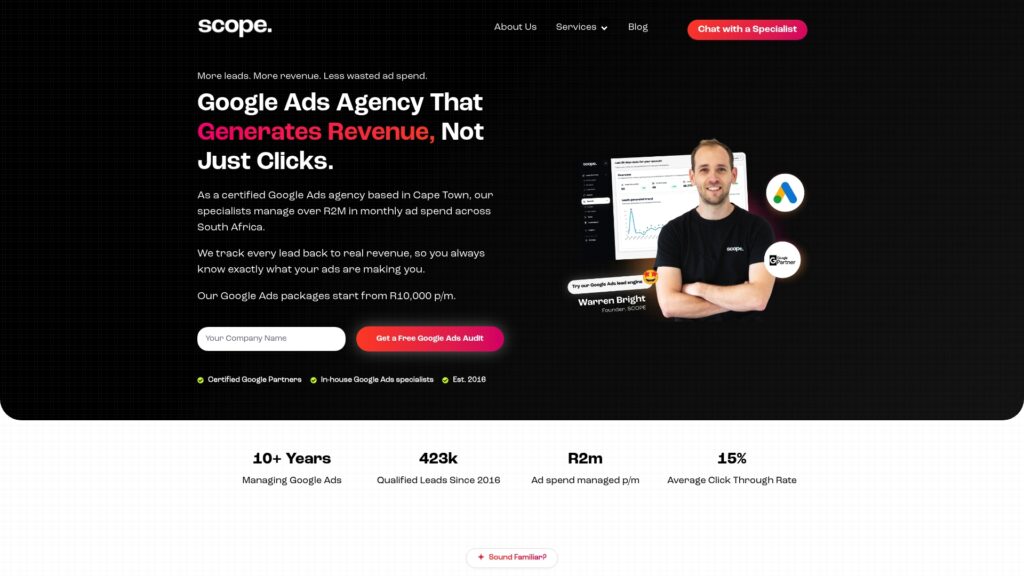
SCOPE is a Cape Town-based paid media agency that specialises in Google Ads for service-based businesses. We audit tracking setups, rebuild campaign structures around buyer intent, and align landing pages with ad copy to reduce wasted spend and increase qualified leads.
Whether you need a full account audit or a fresh campaign build, our team handles the technical and strategic work so you can focus on running your business. Browse our Google Ads resources or get in touch with SCOPE directly to discuss what your campaigns need.
FAQ
Why are my Google Ads getting clicks but no conversions?
Clicks without conversions usually point to a landing page problem or a tracking error. Check that your landing page matches the ad’s promise and that your conversion tag fires correctly on the confirmation page.
How long should I wait before judging a new Google Ads campaign?
Smart Bidding needs 2 – 4 weeks for standard campaigns and 4 – 6 weeks for Performance Max to exit the learning phase. Draw conclusions only after that window and after accumulating at least 100 – 200 clicks.
What is a good conversion rate for Google Ads?
Conversion rates vary by industry, but a well-structured campaign targeting high-intent keywords typically achieves rates well above 3%. A bounce rate above 70% and a conversion rate below 3% both signal landing page or targeting problems.
Why does my Google Ads data not match my CRM?
Discrepancies of 10 – 15% between Google Ads and CRM data are normal due to attribution windows and time zones. A gap above 40% indicates a tracking issue that needs fixing before you can trust your campaign data.
How do I reduce wasted spend on Google Ads?
Build a negative keyword list from launch, separate informational and transactional keywords into distinct campaigns, and review your search terms report weekly. Broad match keywords are the most common source of wasted budget when left unmanaged.